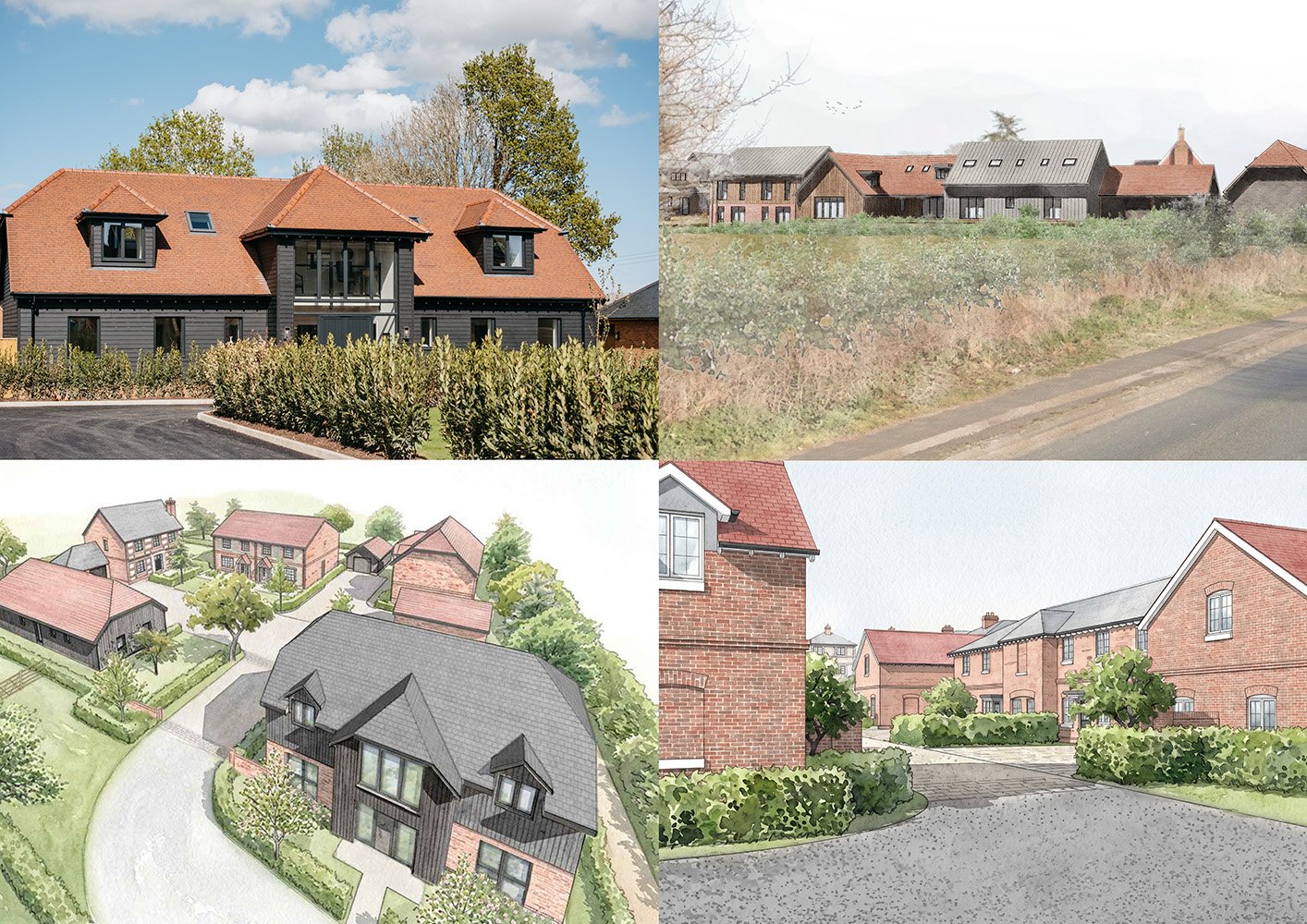
We’ve had growing demand in recent years for vernacular housing developments in rural Hampshire, particularly schemes that take inspiration from traditional agricultural buildings and their surrounding landscape.
Over the past year or two, we’ve noticed something interesting in our developer work. Almost without realising it, a growing proportion of our projects have become agricultural vernacular schemes in rural locations—farmstead layouts, barn-inspired forms, and simple, robust material palettes of brick, tile, slate and weatherboarding.
It’s a noticeable shift. Not that long ago, much of the developer housing market—particularly in the South East—was defined by Georgian or Queen Anne-inspired styles, often applied as a familiar and popular architectural language across many types of development. Symmetry, sash windows and balanced proportions formed a well-established design approach.
Now, increasingly, the brief is different. Developers are asking for schemes that feel more rooted in place—less about formal architectural styling and more about context, heritage and authenticity. The rise of barn-style homes, courtyard groupings and looser, farmstead-inspired layouts reflects this change.
So what’s driving it?
There are likely a few overlapping factors at play.
1. The nature of available sites
Many opportunities now coming forward—particularly outside major settlements—are former agricultural sites or land on the edge of villages. Responding to that history with a vernacular approach is often a natural and appropriate design direction, both visually and in planning terms.
2. Planning policy and design guidance
There has also been a broader shift within planning policy. The National Planning Policy Framework places strong emphasis on well-designed development that responds to local character, encouraging schemes that reflect the defining qualities of their surroundings. [gov.uk]
Alongside this, local authorities are increasingly using design guides and codes to set clearer expectations for development, often promoting locally distinctive architectural responses from the outset.
Together, these influences tend to favour designs that draw on established rural building forms, particularly in countryside settings.
3. Market appeal and buyer expectations
There also appears to be a shift in what buyers respond to. Homes that suggest a sense of rural authenticity—even when newly built—have clear appeal, with the enduring popularity of barn conversions and farm cottages informing expectations for new development.
4. A more informal approach to layout and placemaking
Compared to the symmetry and discipline of Georgian-inspired design, farmstead schemes allow for more informal and varied compositions. This can result in more engaging spaces—courtyards, shared surfaces and framed views—and often contributes to a stronger sense of place.
A quieter shift
What’s perhaps most interesting is that this change hasn’t come about through any single moment or directive—it’s been gradual. As designers, we’ve simply responded to individual sites, client briefs and planning contexts, and only in looking back does the pattern become clear.
Projects like Oak Field Gardens in Sherborne St Johns demonstrate this approach in practice: modest in scale, rooted in the history of the site, and drawing on agricultural forms to create something that feels both familiar and well suited to its setting.
Where next?
Is this a long-term shift, or simply a reflection of the types of sites currently being promoted? It’s likely a combination of both. Greater emphasis on character, context and distinctiveness, together with market demand, suggests this direction is unlikely to be short-lived.
For now, agricultural vernacular represents a credible and well-received approach to rural housing, balancing planning considerations, commercial requirements and a strong sense of place.
If you’re exploring the potential of a rural site or looking to shape a development that responds positively to its setting, we’d be very happy to have a conversation.